Daily Life
Clothing Donation and Textile Recycling in China: A Guide for Foreign Residents
Sort, donate, resell, or recycle unwanted clothing in China while checking collection legitimacy, condition rules, and privacy risks.
Rules and procedures can change. Check the linked official sources before acting on time-sensitive information.
Quick answer
What you need to know
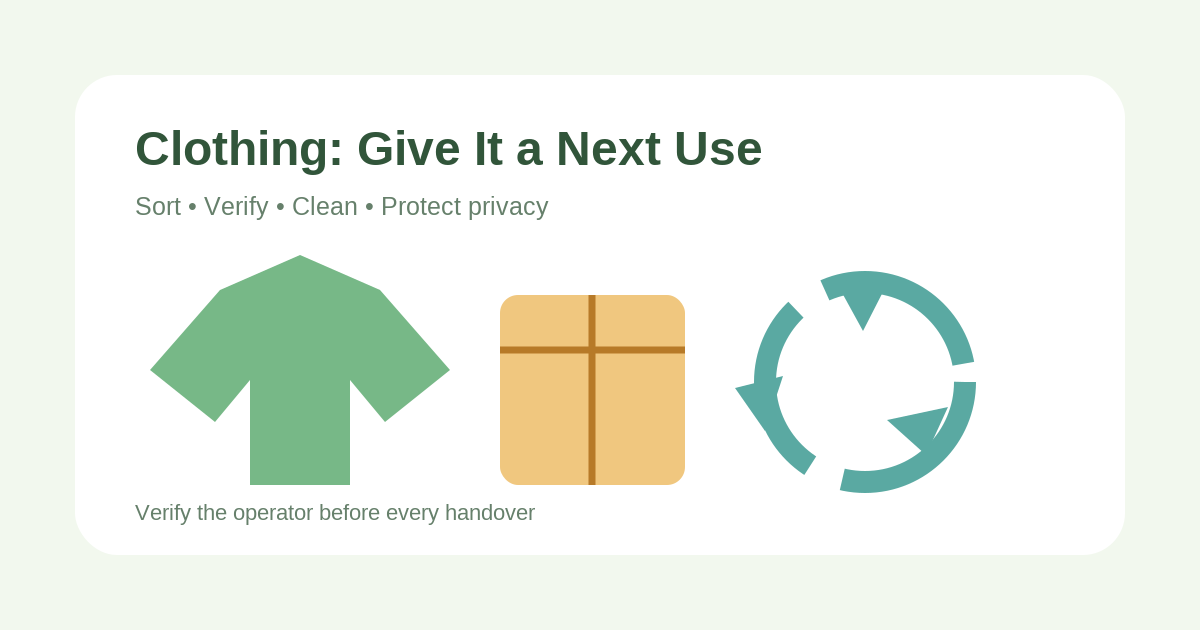
A practical workflow for sorting unwanted textiles, verifying charities or collection services, preparing items, protecting personal data, and keeping realistic expectations about reuse.
- Separate wearable donations, resale items, repairable textiles, recyclable material, and ordinary waste.
- Verify who operates a collection bin, pickup service, or campaign and what happens to the material.
- Remove names, school labels, access cards, receipts, and anything left in pockets before handover.
- Do not describe unusable, wet, moldy, or contaminated clothing as a donation.
An “old clothes” bin may support charity, commercial resale, fiber recovery, or a mix of uses. Decide what outcome you want, then verify the recipient instead of treating every collection point as equivalent.
Sort by realistic next use
Create five groups: clean wearable donations, resale items, repairable pieces, textiles accepted for recycling, and material that must enter ordinary waste. Shoes, bedding, uniforms, underwear, pillows, luggage, and damaged fabric may follow different rules.
Do not donate wet, moldy, pest-affected, badly stained, or contaminated textiles. The mold and humidity guide explains why affected material needs careful handling rather than casual redistribution.
Verify the collection route
For a charity drive, check the organizer’s legal or institutional identity, named recipient, accepted items, deadline, transport arrangement, and stated use. For a neighborhood bin or pickup mini program, photograph the operator name and contact information and read whether material is donated, exported, resold, or recycled.
Be cautious with claims that use a charity’s name without a verifiable partnership. China’s Charity in China information platform and local civil-affairs channels can help with official charity information; availability and records may be Chinese-language.
Prepare items safely
Wash and dry wearable items unless the recipient says otherwise. Empty every pocket and remove name labels, school tags, company badges, tailoring slips, access cards, receipts, and tracking labels. Do not include medicines, batteries, electronics, sharp objects, or confidential papers.
Use separate, clearly marked bags if the service distinguishes donation from fiber recycling. Photograph higher-value handovers when a receipt or chain of custody matters.
Consider alternatives
Good-condition pieces may be resold through a reputable secondhand channel; see the secondhand shopping guide for transaction safeguards. Repair may be more useful than replacement, especially for shoes or tailored clothing.
For a community collection, ask property management where bags can be stored and when they will be removed. Do not leave material in fire exits, lift lobbies, or beside an unverified bin. The waste sorting guide covers local disposal categories.
Clothing handover checklist
- Choose donation, resale, repair, recycling, or waste.
- Read the recipient’s accepted-item rules.
- Verify the operator and claimed destination.
- Exclude wet, moldy, contaminated, or prohibited items.
- Wash and fully dry wearable clothing.
- Empty pockets and remove identity labels.
- Separate and mark bags as instructed.
- Keep receipts or handover evidence when needed.
Frequently asked questions
Common questions
Can I put any old clothing in a China textile collection bin?
No. Rules vary by operator and city. Read the accepted-item list and exclude wet, moldy, contaminated, or prohibited materials.
Are all clothing collection bins charitable?
Do not assume so. Some collections are commercial recycling operations. Check the operator, contact details, stated destination, and any charity authorization or partner claim.
Should donated clothes be washed?
Wearable items should generally be clean and dry, but follow the recipient's specific requirements. Bag and label items only as requested.
Can I receive a donation receipt?
Ask the recipient before donating. Receipt availability, eligible items, valuation, and any tax treatment depend on the organization and applicable rules.