Daily Life
Damaged Renminbi Banknotes in China: An Exchange Guide for Foreign Residents
Handle torn, stained, incomplete, or damaged renminbi banknotes in China with practical steps for preservation, bank enquiries, documentation, and counterfeit concerns.
Rules and procedures can change. Check the linked official sources before acting on time-sensitive information.
Quick answer
What you need to know
A practical guide to preserving a damaged RMB note, asking a bank about official assessment, keeping fragments together, and avoiding informal or unsafe workarounds.
- Keep all fragments flat and together; do not wash, trim, recolor, laminate, or alter the note.
- Ask a staffed bank branch about the current official assessment and exchange process.
- Bring identification and explain how the note was damaged, while recognizing branch procedures may vary.
- Separate suspected counterfeit currency from ordinary damage and ask the bank or police for the proper process.
Cash is less central to many daily transactions in China, but a torn, wet, burned, stained, or incomplete renminbi note can still appear in change, a stored emergency envelope, or after a household accident. Preserve it carefully and let a bank make the assessment.
Preserve the note as you found it
Collect every fragment and let a wet note air-dry on a clean, flat surface away from heat. Place the dry note or pieces in a transparent sleeve. Do not wash, iron, trim, recolor, laminate, scrape, or combine pieces from different notes. Avoid writing on it or covering serial numbers and security features.
Photograph the front, back, pieces, and circumstances for your own records. If the cash was damaged in a rental incident, keep it separate from the repair documentation described in the household inventory guide.
Ask a staffed bank branch
Choose a full-service branch rather than relying on an ATM or merchant. Bring the damaged note, all fragments, your passport or other accepted identification, and your bank card if you are a customer. Explain when and how the damage occurred. Ask whether the branch can assess it directly, needs a specialist counter, or will direct you elsewhere.
The People’s Bank of China publishes official currency information and rules at pbc.gov.cn. Assessment standards and branch handling can change, so ask the bank to apply the current official process. Do not rely on an online photo estimate as a guarantee of full, partial, or zero exchange value.
Keep the transaction understandable
Before handing over the note, ask what receipt or assessment record will be provided and whether there is any processing time. If language is a barrier, prepare a short note such as 我想咨询残缺污损人民币兑换 (“I would like to ask about exchanging damaged RMB”). Keep any receipt until the case is finished.
If you need cash while the assessment is pending, use the backup ideas in the payment outage guide rather than accepting an informal discounted exchange from a stranger.
Treat suspected counterfeits differently
Damage and authenticity are separate questions. If the note’s origin, print, texture, watermark, or other feature makes you suspect it is counterfeit, do not attempt to spend, exchange informally, or return it to circulation. Keep it separate and ask a bank or the police for the correct official handling process. Record where you received it without accusing an individual before assessment.
Damaged-banknote checklist
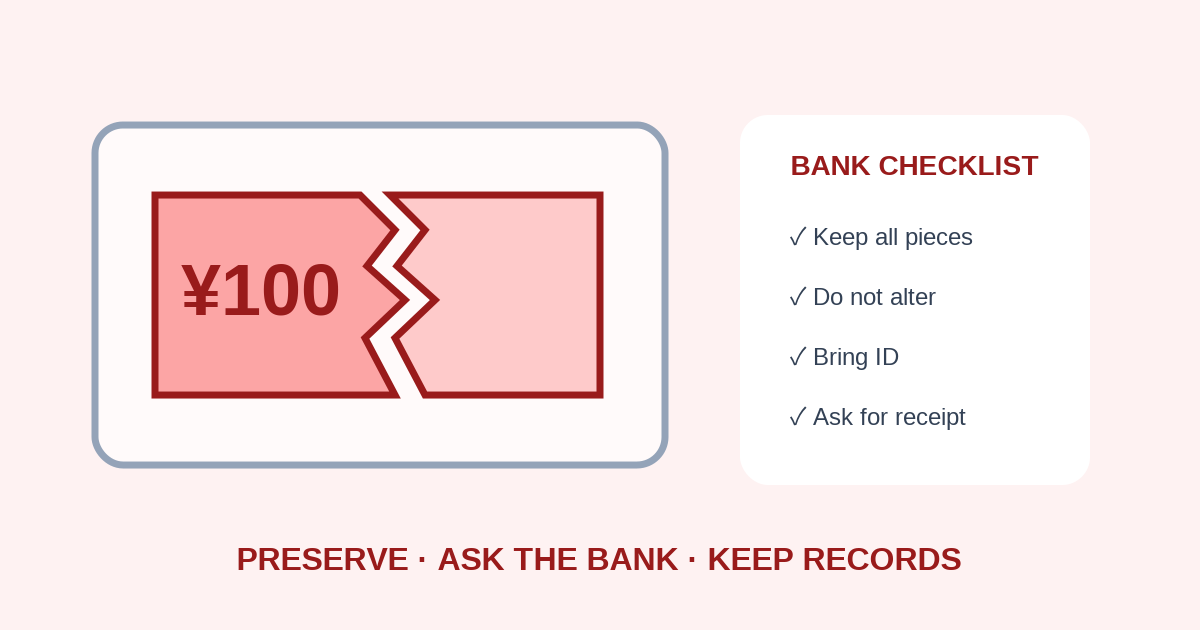
- Collect every fragment and keep pieces from each note together.
- Air-dry naturally; do not iron, wash, trim, color, or laminate.
- Store the note flat in a transparent sleeve.
- Photograph both sides and the damage.
- Visit a staffed bank branch with accepted identification.
- Ask about assessment, exchange value, timing, and receipt.
- Keep suspected counterfeit notes separate and do not recirculate them.
- Save records until the bank process is complete.
This is general financial and practical guidance, not a guarantee of exchange value or legal advice. Currency assessment depends on the current official rules and the note’s condition; confirm the process with the People’s Bank of China, a receiving commercial bank, or the police as appropriate.
Frequently asked questions
Common questions
Will every damaged RMB note be exchanged at full value?
Not necessarily. The official assessment considers the note's remaining identifiable area and condition. Ask a bank to apply the current rules rather than estimating the value yourself.
Should I tape a torn banknote together?
Keep every piece together, but avoid repairs that obscure features or complicate assessment. Place the pieces flat in a transparent sleeve and ask the receiving bank what it prefers.
Can a shop refuse a badly damaged note?
A cashier may be unable to verify or process a damaged note. Do not argue at the counter; use another payment method and take the note to a staffed bank branch for assessment.
What if I think the note may be counterfeit?
Do not try to spend it or pass it to someone else. Keep it separate and ask a bank or the police about the official handling process.