Daily Life
Labeling Circuit Breakers in a China Apartment: A Safety Guide for Foreign Residents
Map and label a China apartment electrical panel safely, with practical steps for landlord approval, bilingual labels, appliance checks, outages, and maintenance records.
Rules and procedures can change. Check the linked official sources before acting on time-sensitive information.
Quick answer
What you need to know
A cautious workflow for identifying an apartment's electrical panel, documenting circuits, creating useful bilingual labels, and knowing when to stop and call property management or a qualified electrician.
- Ask the landlord or property office for the panel diagram and approval before testing or adding labels.
- Map circuits with another adult, one breaker at a time, without removing covers or touching wiring.
- Use removable bilingual labels that identify rooms, fixed appliances, and any circuits that remain uncertain.
- Treat heat, burning smells, buzzing, repeated trips, exposed conductors, or water near the panel as professional-service issues.
An unfamiliar breaker panel becomes important during a power failure, a leaking appliance, or an electrical smell. A clear map can save time, but experimenting inside a live panel can create a serious hazard. The goal is documentation, not electrical work.
Start with the building records
Photograph the closed panel, its existing labels, meter reference, and nearby wall. Ask the landlord or property-management office for the circuit schedule, recent renovation records, and the correct emergency contact. Confirm whether tenants may add removable labels. Never cover warning notices, seals, serial numbers, or original markings.
First locate the safe household controls described in the utility shutoff guide. Do not assume the apartment panel controls common-area lighting, lifts, fire systems, or the building’s main supply.
Map circuits without opening the panel
Choose daylight, save computer work, and switch off sensitive electronics. Work with another adult: one person stays at the closed panel while the other checks lights and outlets. Operate only the normal breaker handles, test one circuit at a time, and restore it before continuing. Do not test medical equipment, security systems, aquariums, refrigerators, or other critical loads without an appropriate continuity plan.
Record the rooms, outlets, lights, air conditioners, water heater, induction cooker, oven, washer, and other fixed loads affected. A plug-in lamp can help check ordinary outlets, but it does not prove wiring condition or grounding. Mark uncertain results as “unknown”—never guess.
Make the map usable under stress
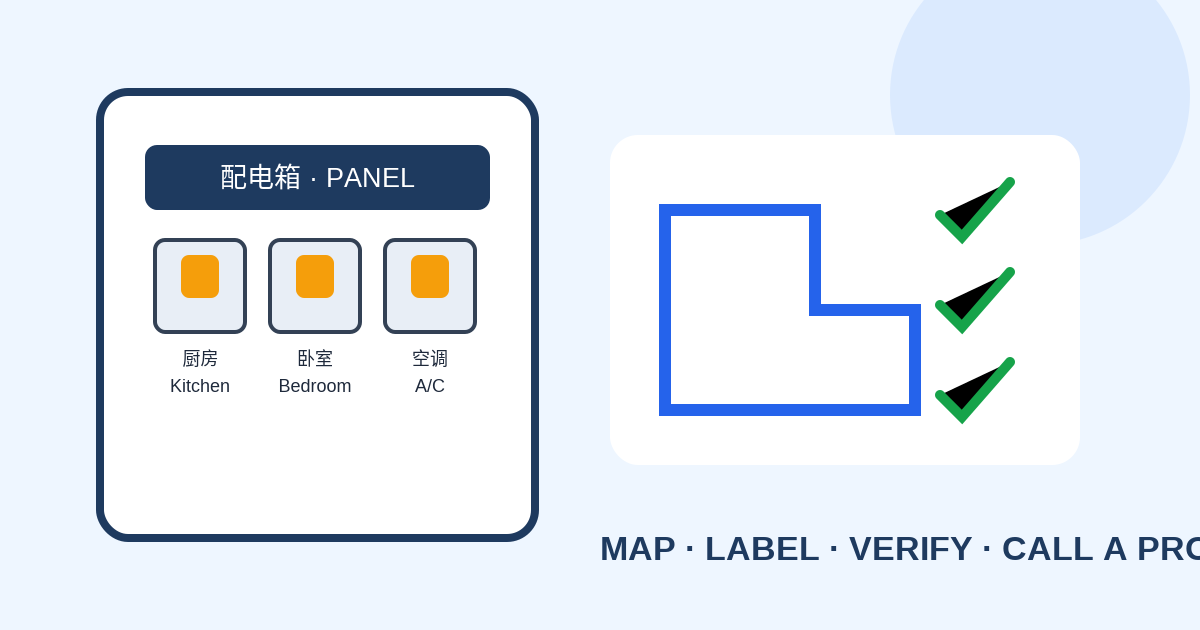
Create a simple table with breaker number, original Chinese text, your translation, observed area, fixed appliance, test date, and notes. Add short removable labels such as 厨房插座 / Kitchen outlets or 主卧空调 / Main bedroom AC. Keep a photo and a digital copy accessible to household members.
If the observed circuit differs from the building diagram, stop and report the discrepancy. The power and water outage guide explains how to distinguish an apartment problem from a building or neighborhood outage.
Know when documentation is not enough
Stop using the affected circuit and contact property management or a qualified electrician if you notice heat, discoloration, burning odor, buzzing, sparking, exposed conductors, water, a loose panel, or repeated trips. Do not tape a breaker on, replace it with a larger rating, bypass a protective device, or make wiring changes yourself.
China’s National Fire and Rescue Administration publishes official fire-safety information at 119.gov.cn. Building design, local practice, and equipment differ, so confirm technical requirements with the landlord, property office, utility, or qualified electrician.
Breaker-panel labeling checklist
- Photograph the closed panel and all existing markings.
- Request the circuit schedule and emergency contacts.
- Obtain permission for removable labels in a rental.
- Test only normal handles, one circuit at a time, with another adult.
- Avoid critical loads and never remove internal covers.
- Record breaker number, Chinese text, rooms, outlets, appliances, and date.
- Mark uncertain circuits as unknown and request professional checking.
- Keep the map near the panel and in a household emergency file.
This is general household-safety guidance, not electrical or legal advice. Do not open sealed or internal electrical compartments. Confirm any inspection, repair, or alteration with property management, the landlord, the utility, and a qualified electrician.
Frequently asked questions
Common questions
Can I open the electrical panel cover to identify wires?
Do not remove an internal cover or touch wiring unless you are a qualified electrician authorized to do the work. Ask property management or the landlord to arrange a qualified professional.
Why does one breaker control outlets in several rooms?
Apartment circuits do not always match room boundaries, especially after renovations. Record what you observe and have uncertain or inconsistent circuits checked professionally.
Should I reset a breaker that keeps tripping?
A repeated trip may indicate an overload, faulty appliance, wiring issue, or moisture. Unplug suspect equipment and contact property management or a qualified electrician rather than repeatedly resetting it.
What language should the labels use?
Chinese plus a language understood by the household is practical. Keep labels short, include room or appliance names, and leave the original markings visible.