Family & Education
School Exam Accommodations in China: A Guide for Foreign Families
Request and manage school exam accommodations in China with current documentation, application deadlines, classroom alignment, privacy, and appeal planning.
Rules and procedures can change. Check the linked official sources before acting on time-sensitive information.
Quick answer
What you need to know
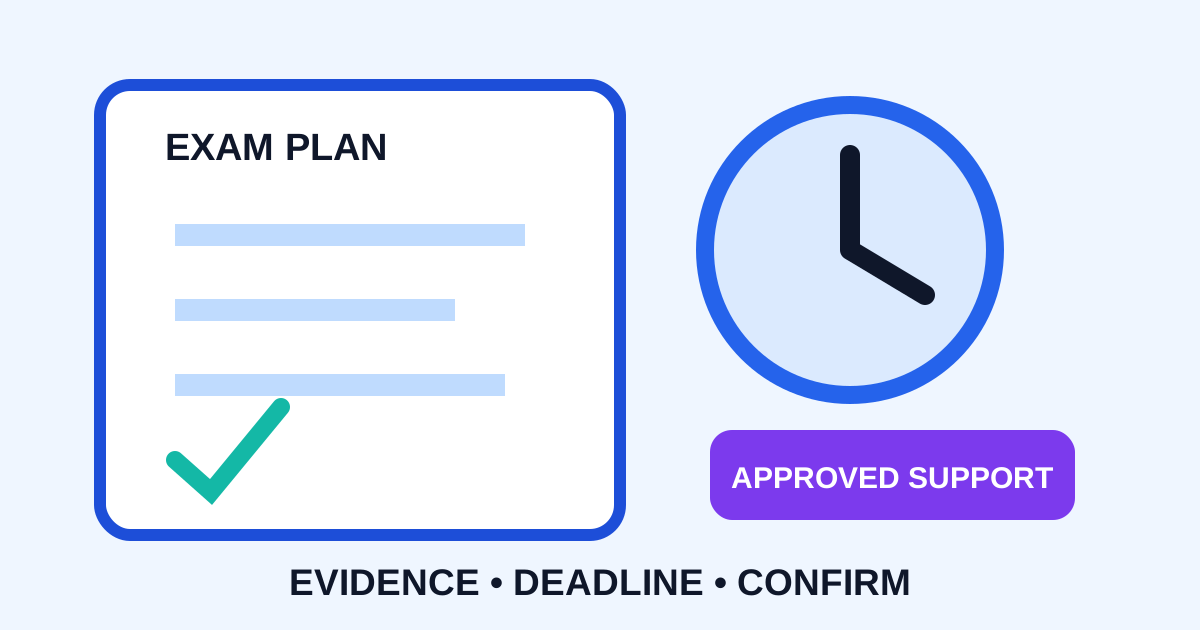
Ask which rules govern each assessment, submit current evidence through the official process, practice approved arrangements in class, and verify the final exam plan before test day.
- School tests, external examinations, and admissions assessments may use different accommodation rules.
- Start early because evidence, approval, equipment, rooms, and deadlines can take time.
- Use qualified educational or clinical documentation that answers the receiving body's current criteria.
- Confirm approved arrangements in writing and rehearse them during ordinary learning where permitted.
Access arrangements can help an assessment measure a student’s knowledge without an unrelated barrier, but the process depends on the school, curriculum, examination body, and type of test. An arrangement used in class is not automatically approved for every external examination.
Identify which rules control the assessment
List ordinary class tests, school examinations, admissions assessments, language tests, and external qualifications separately. Ask who makes the decision for each, where the current policy is published, the application deadline, required evidence, appeal route, and whether approval must be renewed.
Examples may include additional time, supervised rest breaks, a separate room, a reader or scribe, assistive technology, enlarged material, modified paper, or scheduled medical access. Eligibility is not determined by preference alone; the responsible body applies its own criteria.
Start the evidence process early
Ask exactly which qualified professional may assess the need, how current the report must be, what tests or functional evidence it must contain, accepted languages, translation requirements, and whether the school must document normal classroom practice.
Do not purchase an assessment package before confirming that the receiving body accepts it. Keep reports secure and share health or disability information only through the school’s designated confidential process. The special education guide covers broader learning-support coordination.
Align support with everyday learning
Where appropriate, the student should learn to use the approved tool or routine during normal classes: typing on the permitted device, taking supervised breaks, using enlarged text, or working with timing cues. An unfamiliar arrangement introduced only on exam day may add stress.
Ask teachers to record relevant observations and support history factually. Separate English-language development from disability or health access needs unless the applicable policy connects them. For language planning, see the school language support guide.
Confirm logistics in writing
Before the examination, obtain written confirmation of the approved arrangement, subjects, duration, room, equipment, software restrictions, start and finish rules, break supervision, medicine access, and contact person. Check that the student’s legal name and candidate number are correct.
Create a calm student-facing summary without disclosing more private information than necessary. The student should know whom to alert if the arrangement is missing or equipment fails.
Record incidents and review outcomes
If something goes wrong, note the time, room, people notified, missing support, response, and effect without coaching the student to speculate. Follow the school’s or examination body’s incident and appeal deadlines promptly.
After the cycle, review whether the arrangement was useful and whether updated evidence or a new application is needed. Include approvals and reports in the school records file before transfer or graduation.
Exam accommodation checklist
- Every assessment and responsible decision-maker is identified.
- Policy, evidence criteria, deadlines, renewal, and appeal route are saved.
- The proposed assessor and report format are accepted in advance.
- Confidential documents are shared only through approved channels.
- Approved support is practiced during learning where permitted.
- Subjects, room, time, breaks, equipment, and contacts are confirmed.
- The student knows how to report a missing arrangement calmly.
- Incident and next-cycle records will be retained.
China’s Ministry of Education provides national education information. Schools and examination bodies set detailed processes; confirm current criteria directly with them and use qualified professionals for educational or clinical assessments.
Frequently asked questions
Common questions
Does a previous school's accommodation automatically transfer?
Not always. The new school or examination body may require its own application, current evidence, history of use, deadlines, and approval. Start the review early.
What documentation might be required?
Requirements vary, but may include professional assessment, diagnosis or functional evidence, school records, teacher observations, and proof that the arrangement reflects normal classroom practice.
Can a child receive extra time because English is not their first language?
Do not assume so. Language-learning support and disability-related access arrangements may follow different rules. Ask the school and examination body which criteria apply.
What if an approved arrangement is missing on exam day?
The student should alert the invigilator without disrupting the room, while the family or school follows the examination body's incident process and preserves a factual timeline.