Healthcare
Blood Tests and Lab Results in China: A Guide for Foreign Patients
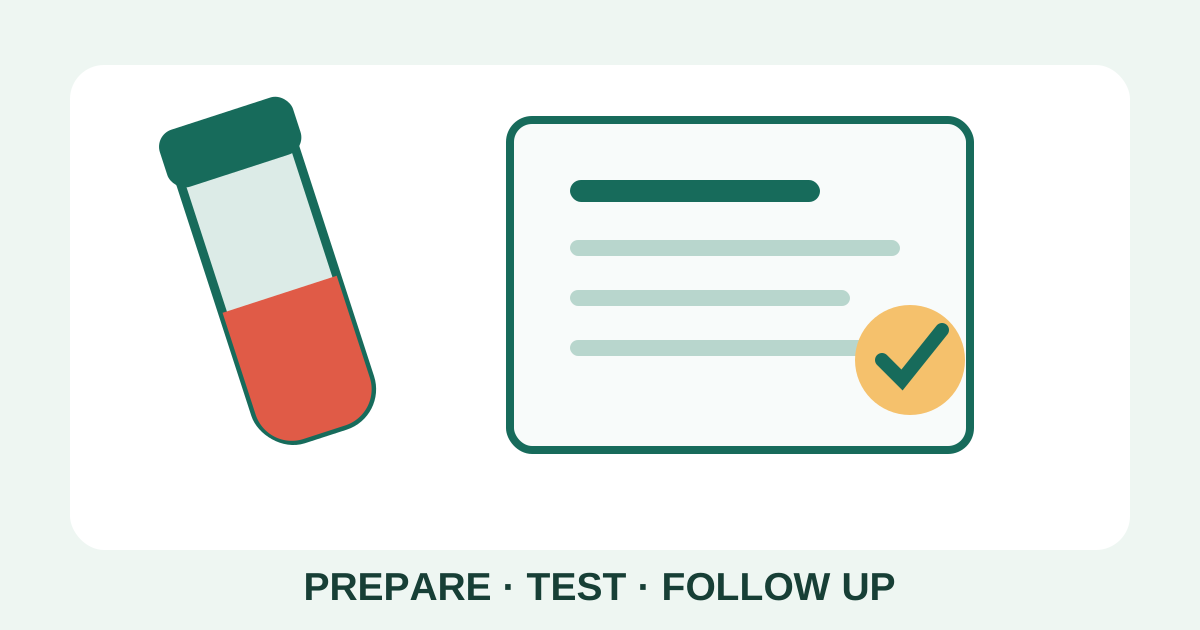
Prepare for blood tests in China, confirm fasting and medication instructions, register correctly, collect reports, interpret reference ranges, and follow up safely.
Rules and procedures can change. Check the linked official sources before acting on time-sensitive information.
Quick answer
What you need to know
Confirm the exact test and preparation instructions, ensure your identity is correct, retain the complete report with units and reference ranges, and ask the ordering clinician—not an app—to interpret results in context.
- Fasting requirements vary by test; get written instructions from the ordering clinic.
- Do not stop prescribed medicine unless the treating clinician specifically tells you to.
- A highlighted result is not a diagnosis and must be interpreted with symptoms, history, units, and the laboratory's reference range.
- Urgent symptoms require medical attention even if an app or report appears reassuring.
Blood testing in China can be fast and convenient, but unfamiliar registration systems, Chinese test names, app-only reports, and different reference ranges can make a routine appointment confusing. The safest approach is to clarify the order before the sample and plan the follow-up before leaving.
This article provides general logistical information, not medical advice or interpretation. Follow instructions from the clinician and laboratory responsible for your test. Seek urgent medical care for serious or worsening symptoms regardless of a report.
Confirm the order and purpose
Ask the ordering clinician for the exact test names and why they are being requested. Clarify whether the order is for diagnosis, medication monitoring, an employment or immigration examination, or routine screening. These purposes may use different panels and documentation.
Confirm which hospital campus or laboratory can perform every ordered item, whether an appointment is needed, the expected cost, insurance or direct-billing arrangements, and when results should be ready.
Get preparation instructions in writing
Do not assume all blood tests require fasting. Ask:
- whether fasting is required and for how many hours;
- whether plain water is allowed;
- how to handle prescribed medicines and supplements;
- whether alcohol, coffee, smoking, or exercise should be avoided;
- whether the time of day or menstrual cycle matters; and
- what to do if you are ill on the test date.
Never stop a prescribed medicine merely because you are fasting. Contact the treating clinician for individualized instructions, especially for diabetes medicine, anticoagulants, or any drug where timing matters.
Register with the correct identity
Bring the passport or identity document used in your hospital profile, the order, and insurance details. Check the name, passport number, birth date, and sex marker on labels and receipts. A mismatch can separate results from your medical record or complicate a claim.
If the hospital has profiles under both an old and new passport, ask staff to link or correct them. The name-consistency guide gives a record-matching workflow.
At the collection desk
Tell staff if you have previously fainted during blood collection, take medicine affecting bleeding, have an adhesive allergy, or need to lie down. Follow the collector’s instructions and apply pressure afterward for the recommended time.
Before leaving, confirm how results will arrive: printed report, hospital app, mini-program, SMS link, or collection desk. Ask whether every item is complete, because specialist tests may report later.
Preserve the complete report
Save the original PDF or clear images, not only a translated summary. A useful report includes patient identity, collection date and time, test name, numerical value, unit, laboratory reference range, flags, specimen type where relevant, and laboratory details.
Translation tools can help you recognize terms, but verify consequential translations. Units such as mmol/L and mg/dL are not interchangeable without a correct conversion, and reference ranges can vary by method and laboratory.
Arrange interpretation and follow-up
Book follow-up with the clinician who ordered the test or another qualified professional who can review the reason for testing, symptoms, examination, medicines, prior values, and current report. A red arrow may reflect a small statistical variation; an unflagged value does not exclude every problem.
Ask what the result means, whether the test should be repeated, what symptoms require urgent care, whether treatment changes are proposed, and when the next review is due. Do not change medicine based solely on an automated interpretation.
For reimbursement, retain the order, itemized invoice, payment receipt, complete results, clinician note, and any insurer preauthorization. Our medical insurance claims guide covers the paperwork.
Blood-test checklist
- I know the exact ordered tests and their purpose.
- The clinic confirmed fasting and medication instructions.
- The correct passport identity appears on my hospital profile.
- I disclosed fainting, bleeding, and allergy concerns.
- I know when and where every result will be released.
- I saved the original report with units and reference ranges.
- Translation or unit conversion will be independently checked.
- A qualified clinician will interpret the result in context.
- I kept documents needed for insurance or official use.
Reliable reference points
- National Health Commission of China
- World Health Organization: China
- International Federation of Clinical Chemistry and Laboratory Medicine
Hospital workflows and test methods differ. The ordering clinic and performing laboratory are the primary sources for preparation, result timing, and interpretation.
Frequently asked questions
Common questions
Do I need to fast before a blood test in China?
Only some tests require fasting. Ask the ordering clinic how many hours, whether water is allowed, and how to handle medicines, coffee, alcohol, smoking, and exercise.
Why is a result marked high when it was normal elsewhere?
Laboratories can use different methods, units, and reference ranges. Compare the value using the range printed on that report and ask the clinician to interpret the trend.
Can I get an English lab report?
Some international departments and private facilities provide bilingual reports, while others do not. Ask before testing and obtain a complete original even if you later arrange translation.
Can an AI app interpret my blood test?
An app may help translate terms but cannot safely replace a clinician who knows your symptoms, history, medication, examination, and the laboratory method.