Visas & Residence
Notarization, Apostille, and Translation for Documents Used in China
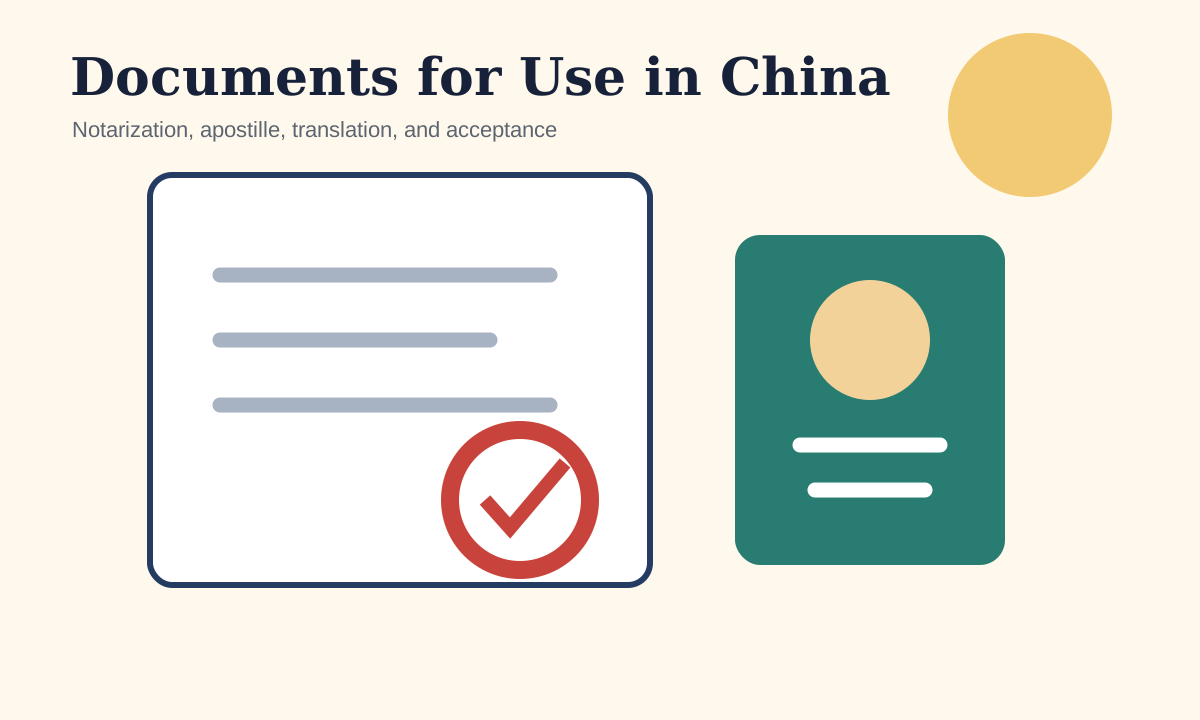
A practical document-preparation guide for foreigners using overseas certificates in China, including destination requirements, apostilles, notarization, translation, copies, and validity.
Rules and procedures can change. Check the linked official sources before acting on time-sensitive information.
Quick answer
What you need to know
Before preparing an overseas document for use in China, ask the receiving authority for a written checklist identifying the exact document, issuing country, notarization or apostille route, translation standard, copy format, and validity period.
- The receiving Chinese authority, not a generic online guide, determines what it will accept.
- An apostille confirms origin-related formalities; it does not translate a document or guarantee acceptance.
- Requirements differ by document, issuing country, purpose, city, and application date.
- Use the official authority or a qualified professional for case-specific confirmation.
Foreign residents often need overseas degrees, police certificates, birth certificates, marriage certificates, or professional records for work, residence, school, family, or civil procedures in China.
The difficult part is that “notarized” is not a complete instruction. The correct chain depends on the issuing country, document type, purpose, destination authority, and date of application.
1. Begin with the receiving authority
Ask the organization that will accept the document for a written checklist. Confirm:
- exact document name and issuing authority;
- original, certified copy, or electronic record;
- notarization requirement;
- apostille or other authentication route;
- Chinese translation requirements;
- translator or agency qualifications;
- validity or recent-issue period; and
- whether names must match the passport exactly.
Do this before paying an intermediary or mailing an irreplaceable original.
2. Understand the separate steps
Notarization, apostille, consular legalization, and translation are not synonyms.
- Notarization may certify a signature, copy, declaration, or other fact under the relevant jurisdiction.
- Apostille is a certificate used between parties to the Hague Apostille Convention for covered public documents.
- Consular legalization may remain relevant when the Convention does not apply.
- Translation makes the content readable in the required language but does not replace authentication.
China’s Ministry of Foreign Affairs states that the Apostille Convention took effect for China on November 7, 2023. Check the Convention’s official status table and the competent authority in the document’s country of origin.
3. Check whether the document is eligible
Some records are public documents; others are private documents that may first need notarization. Electronic documents, background checks, diplomas, and civil records may follow different routes.
Ask the competent authority in the issuing country what it can apostille, notary requirements, fees, processing time, and verification method.
4. Solve name and date mismatches early
Compare the passport with every certificate. Identify middle names, former names, transliteration differences, reordered names, and changed passport numbers.
The receiving authority may request a declaration, name-change certificate, marriage certificate, or other linking evidence. Do not alter documents yourself.
5. Confirm translation specifications
Ask whether the translation must be completed in China, carry a translation company’s stamp, include the translator’s statement, reproduce seals, or be attached to the source document.
For work-permit preparation, coordinate with employer HR and read China Work Permits. For family records, see Bringing Family to China.
6. Protect originals and track validity
Use tracked delivery where available, scan every page, and record which office holds each original. Keep the apostille attached as issued.
Some applications require recently issued records. Confirm the acceptable window before ordering a police certificate or medical record too early.
Document preparation checklist
- I have the receiving authority’s current written checklist.
- I confirmed the issuing country and competent authority.
- I know whether notarization comes before apostille.
- I confirmed whether the Convention applies.
- I checked translation and copy specifications.
- I resolved name and passport mismatches.
- I checked document validity and application timing.
- I scanned and tracked every original.
Official sources
- Ministry of Foreign Affairs of China: Apostille Convention
- HCCH: Apostille Section
- China Consular Service Network
This guide is not legal advice. Requirements can change, so confirm the exact chain with the receiving authority, the competent authority in the issuing country, or a qualified professional.
Frequently asked questions
Common questions
Does China accept apostilles?
The Apostille Convention entered into force for China on November 7, 2023, but whether a particular document needs and can receive an apostille depends on its origin, destination, and use.
Does an apostille replace Chinese translation?
No. An apostille and a translation serve different purposes. The receiving authority may still require a Chinese translation in a specified format.
Is consular legalization still needed?
It may still be relevant where the Apostille Convention does not apply or for documents outside its scope. Confirm the current route with competent authorities.
Can I use a scan instead of the original?
Only if the receiving authority allows it. Ask whether it needs an original, certified copy, color copy, electronic verification, or document returned in a sealed envelope.